Nigeria spends $155m on palm oil imports as local output stalls
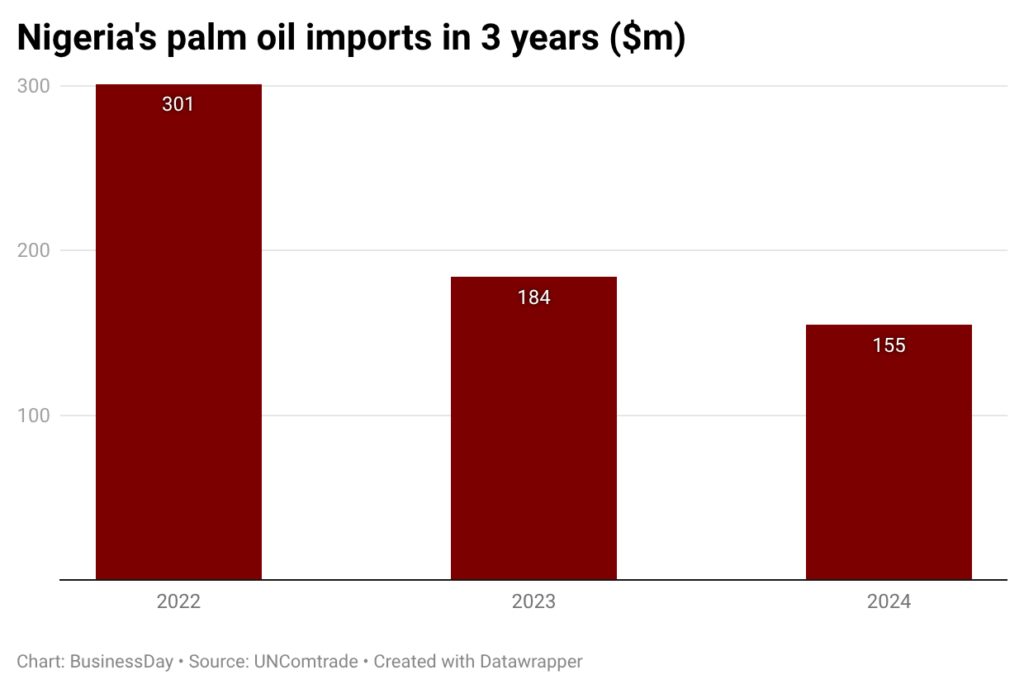
Nigeria's reliance on $155 million in palm oil imports last year underscores a massive supply deficit that strains foreign exchange reserves and stifles agricultural export potential.
Nigeria spent $155 million on palm oil imports in 2024 to bridge a domestic supply gap, according to UNcomtrade data. The country consumes an estimated 2.7 million tonnes of the commodity annually but only produces 1.5 million tonnes. This deficit forces food processors and traders to rely heavily on Indonesia and Malaysia.
The import bill adds direct pressure to Nigeria's foreign exchange reserves at a time when food inflation is already a critical economic constraint. The financial drain is a stark reversal for a nation that once dominated the global market. “We once controlled and contributed 43 percent of global crude palm oil supply, but now can only produce a miserly two percent,” said Joe Onyiuke, national president of the Oil Palm Growers Association of Nigeria.
Malaysia illustrates the scale of the missed opportunity. After British administrators took palm oil seedlings from Nigeria in the 1870s, the Southeast Asian nation built an integrated supply chain that generated $27.5 billion in export earnings in 2025. The sector now accounts for 3 percent of Malaysia's GDP and supports three million jobs.
Malaysia produced 20.28 million tonnes of palm oil in 2025, capturing 24.1 percent of global supply and exporting to over 150 countries. This scale was achieved through deliberate government intervention, including replanting schemes, integrated milling infrastructure, and heavy investment in traceability. “Malaysia has successfully developed a globally competitive palm oil sector through deliberate policies, large-scale investments and innovation. Nigeria can learn valuable lessons from that experience,” said David Iweta, national vice president of the Nigeria Association of Chambers of Commerce, Industry, Mines, and Agriculture.
Nigeria’s production model remains fragmented and inefficient. Eighty percent of the country's palm oil comes from dispersed smallholders harvesting semi-wild plants using manual processing techniques. The sector has been hampered by poor technology, inadequate financing, and chronic policy inconsistencies.
Overcoming this structural deficit requires massive capital allocation. Experts estimate Nigeria needs roughly three million hectares of planted land to achieve self-sufficiency. Recent investments in processing mills offer some optimism for future yield improvements, but a comprehensive national replanting strategy remains absent.
Industry leaders caution against simply copying the Malaysian blueprint. “Nigeria has to develop models unique to its terrain in order to stand competitively on the global market,” Onyiuke said. Without targeted investment in research, processing capacity, and market linkages, Nigeria risks remaining a net importer of a crop it historically exported.