Bitcoin rally masks yield-adjusted weakness amid rising oil
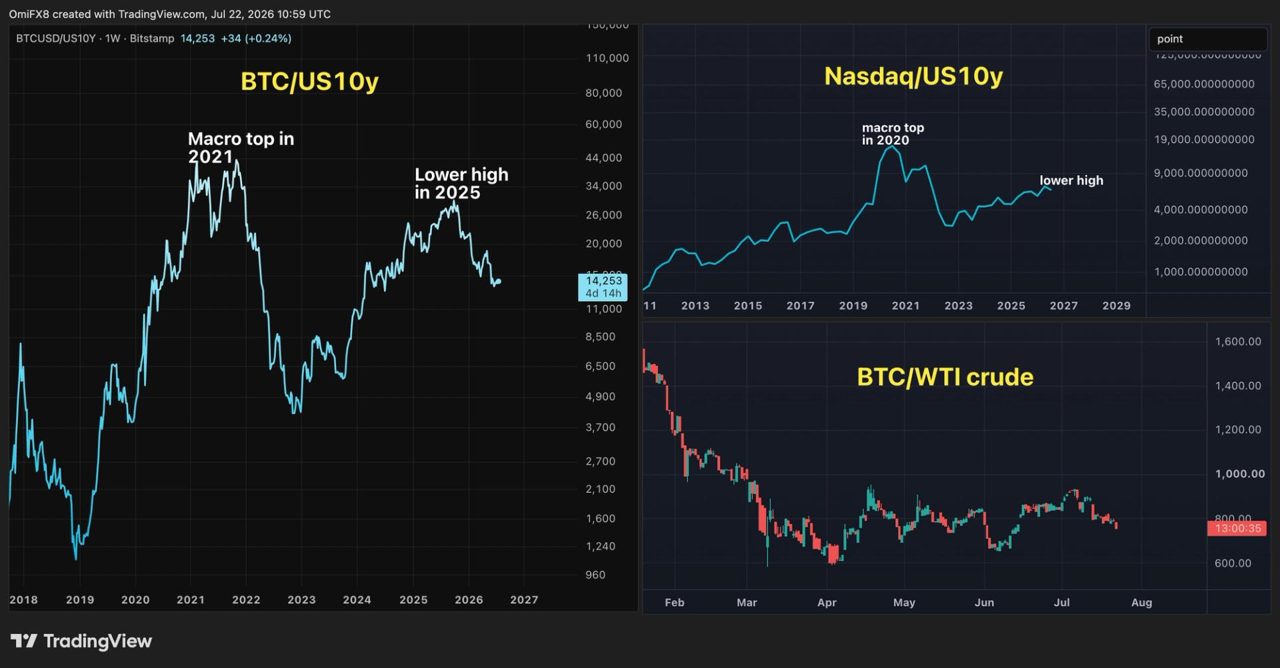
Bitcoin's nominal price gains obscure a structural decline in valuation relative to borrowing costs and a resurgence in energy prices that threatens to trigger a sharp correction.
Bitcoin’s recent rebound from $58,000 to $66,000 conceals underlying fragility in the digital asset market. When measured against the U.S. 10-year Treasury yield, the BTC/US10Y ratio has failed to eclipse its 2020-2021 peak, despite nominal dollar prices setting new records over the past 12 months.
This divergence indicates that the true macro top for bitcoin likely occurred years ago. The Nasdaq exhibits an identical pattern, suggesting that structural weakness pervades the broader technology sector rather than just cryptocurrency.
For this valuation gap to resolve positively, interest rates would need to collapse to shrink the denominator in these calculations. However, Federal Reserve officials have maintained decidedly hawkish rhetoric, with some even floating the possibility of further rate increases. Without a monetary pivot, the more probable outcome is a decline in dollar prices to realign with the weakness shown by the ratios.
Rising energy costs compound this macroeconomic headwind. Oil prices jumped 4% following the 11th consecutive round of U.S. strikes against Iran. Secretary of State Marco Rubio stated that Iran is "not serious" about peace talks, with the Strait of Hormuz remaining a major sticking point.
Crucially, bitcoin’s ratio relative to WTI crude oil futures has declined during its recent bounce. This confirms that oil is outperforming even the most aggressive risk assets, pointing to a new wave of cost-push inflation loading into the global economy.
Sector fractures emerge
This precarious macro backdrop is paralleled by structural failures within the crypto industry itself. Movement Labs filed for Chapter 11 bankruptcy with between $100,000 and $500,000 in assets against more than $1 million in liabilities. Separately, Balance Coin, an algorithmic stablecoin, collapsed 99% after an attacker exploited a pricing flaw to drain $912,000 from its bitcoin vaults.
Legislative gridlock adds another layer of risk. U.S. Senate Democrats are reportedly blocking the Crypto Clarity Act over provisions that would ban government officials from holding significant crypto ties.
For market participants, engineering a sustained bull run appears far more difficult than current sentiment suggests. If oil continues its ascent, a sharp "snap adjustment" where nominal prices fall rapidly to match yield-adjusted realities is a distinct possibility.