Beehive builds 3D-printed drone engine production base
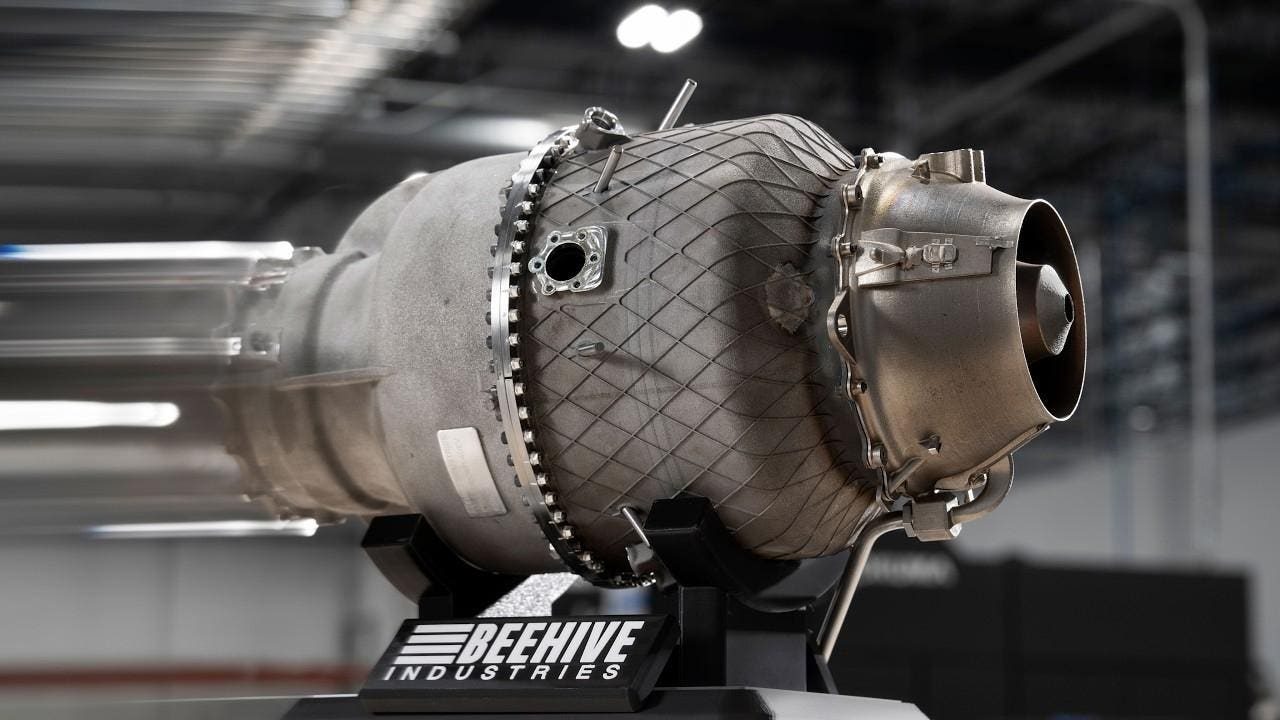
Beehive Industries is pairing a $29.7 million U.S. Air Force contract with heavy equipment and facility investments to build a vertically integrated supply chain for mass-producing 3D-printed drone engines.
Beehive Industries has secured a $29.7 million U.S. Air Force contract and is deploying significant capital to mass-produce its 3D-printed drone engines. The Denver-based company is moving the 200-pound-force-thrust Frenzy 8 into full-rate production after completing high-altitude testing in Ohio in late 2025. The Air Force award covers vehicle integration, flight testing, and qualification of the Frenzy 8, while also funding initial manufacturing of the smaller, 100-pound-force Frenzy 6.
Rather than relying on a traditional network of casting and forging suppliers, Beehive is spending heavily to own the entire production process. The company ordered more than $50 million in metal additive manufacturing systems from EOS, bringing its installed EOS fleet to 50 machines. It also acquired two Ohio machine shops to handle the precision finishing, heat treating, and inspection that printed parts require. “Frenzy is now flight-ready, and our production system is ready to scale alongside it,” said David Kimball, Beehive’s chief technology officer.
The company is organizing these assets to target an annual output of more than 8,000 engines. To support this volume, Beehive announced a $70 million expansion in Southwest Ohio this week, expected to create over 200 jobs. Knoxville will serve as the Production Additive Manufacturing Center of Excellence, while the newly acquired Cincinnati operations will form a Production Machining Center of Excellence.
Beehive is also expanding beyond propulsion to ensure its capital equipment remains highly utilized. It recently acquired ultra-large-format metal 3D printers from Nikon SLM Solutions, featuring build envelopes measuring 600 x 600 x 1,500 millimeters and twelve 1-kilowatt lasers. These machines will be dedicated to printing large aerospace and space structures, such as complete vehicle bodies and satellite substructures, for external defense customers.
The strategy directly targets the Pentagon’s push for "affordable mass," a procurement doctrine prioritizing high-volume, expendable systems over traditional platforms. “This collaboration ensures our warfighters will have the high-volume, mission-ready capabilities they need to maintain a competitive edge in any theater,” said Gordie Follin, Beehive’s chief product officer. For investors, the key metric