Op-Ed: The global reshuffle, who will control the next era of manganese?
The idea that seemingly unrelated facts will point to a hidden conspiracy: Turns out the global manganese supply chain is not so different, writes Nicholas Vafeas.
The idea that seemingly unrelated facts will point to a hidden conspiracy: Turns out the global manganese supply chain is not so different, writes Nicholas Vafeas.
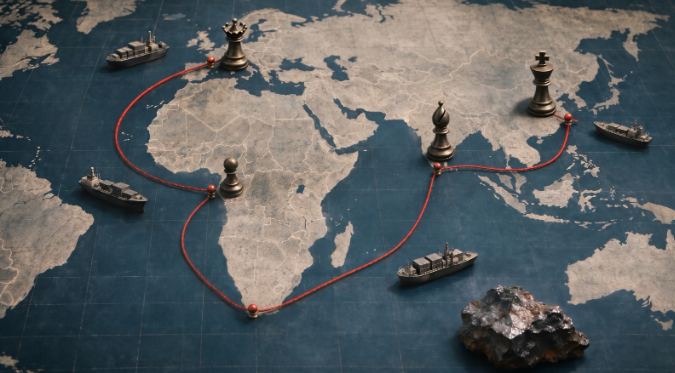
Those who watch detective movies will be familiar with the clue board, joined by red string. The idea that seemingly unrelated facts will point to a hidden conspiracy. Turns out the global manganese supply chain is not so different, you just need to see the string.
In 2025, India bought 4.34 million tonnes of manganese ore and concentrates from South Africa. It then proceeded to sell 1,893 tonnes of silicomanganese back to South Africa to make steel. A relatively small shipment, sure, but why was the world’s largest manganese producer buying finished alloy back from one of its own ore customers? To anyone familiar with South Africa’s electricity woes, the answer is hardly a mystery. But the more important part is what happens when we follow the ore to India.
In 2025, South Africa and Gabon together supplied 97% of India’s imported manganese ore and concentrates by weight. India, in turn, exported 1.25 million tonnes of silicomanganese, with Italy and Japan among its largest buyers. For years, the arrangement has been fairly simple. Africa supplied the rock, India supplied the metallurgy, and the rest of the world placed its orders.
Then Gabon decided that it rather fancied the metallurgy as well. In December 2025, Gabon published a decree banning raw manganese exports from January 2029. Almost a year later, Ghana followed suit, announcing plans to process at least half of its manganese and bauxite domestically by the end of 2028 and prohibit raw exports of both by the end of 2030. Put Gabon and Ghana alongside South Africa, and you are looking at roughly 73% of global manganese mine production in 2025, measured in contained manganese.
For an Indian alloy producer, this creates a rather delicate social problem. In 2024, the European Union imported around 167,000 tonnes of silicomanganese from India, produced largely from African ore. Imagine sitting across the negotiating table from your Gabonese supplier, knowing that in a few years’ time, you may see him again at an Italian steel mill. Only on that occasion, you will both be there to sell the same thing.
Before assuming the supplier is about to steal the customer’s lunch, we should look at what is actually being built. Gabon already operates an alloy plant at Moanda and, under a July agreement with France’s Eramet , could have a considerably larger coastal facility operating by 2031. Ghana’s Nsuta mine , by contrast, has historically supplied its parent company’s facilities in China, and a principal objective of its proposed refinery is to raise the manganese content of its ore from 27% to roughly 40%. Should Ghana continue shipping its upgraded material to China, the old commercial relationship remains unchanged. However, Gabon’s ambition to smelt its own alloy threatens to redraw the map entirely.
Meanwhile, Europe appears to be playing both sides of the board. In November 2025, the African Union and the EU publicly backed African industrialisation in Luanda, backed by a €30 million EU grant to modernise the railway from Moanda to the coast. At the exact same time, Brussels is also trying to keep its own smelters alive. Under the EU’s ferroalloy safeguard , Indian silicomanganese faces additional duties on cheaper imports once its quota is filled. Gabonese silicomanganese, however, is exempt. For anyone thinking about building a furnace in Gabon to supply European steelmakers, that is a rather attractive commercial advantage.
There is, however, the small matter of the calendar. The safeguard is scheduled to expire on 17 November 2028, precisely six weeks before Gabon’s ore export ban takes effect. So, by the time our hypothetical Gabonese furnace starts producing alloy in 2031, the very commercial advantage that helped justify its construction may no longer exist. Gabon gets to decide where its manganese is processed. Brussels, it seems, still gets a considerable say in whether processing it there is a good idea.
Whilst governments busy themselves drawing up export bans, the sharpest operators are repositioning themselves in the middle. Consider OM Holdings, a group with manganese alloy furnaces in Malaysia. In February 2026, OM Holdings sold its indirect stake in South Africa’s Tshipi mine to Exxaro , whilst locking in an agreement to keep marketing its ore . Then by August, an OM subsidiary had agreed to buy concentrate from Australia’s Butcherbird mine , owned by Element 25. Rather neatly, the arrangement also allowed Element 25 to reserve material for its proposed battery-grade manganese refinery in Louisiana. So, in the space of a few months, OM had relinquished its stake in one mine and secured a commercial interest in the output of two. Ownership of the rock, it seems, is far less useful than control over where it goes next.
One last pin for the board. On November 8, Gabon’s mines minister visited Inner Mongolia Xinchuang, a Chinese silicomanganese producer that obtains 35% of its ore from Moanda. Given that Gabon had effectively announced its intention to stop selling the company its raw material, one might have expected a somewhat awkward reception. Instead, in a bout of uncanny foresight, Xinchuang made a suggestion: why not build two alloy plants in Gabon? Suddenly, Gabon finds itself entertaining a distinctly enthusiastic Chinese suitor alongside a rather more financially cautious French one.
Rather interestingly, just three days before that visit, Eramet-Comilog had signed a letter of intent with China’s Sinohydro and the Gabonese government concerning electricity supply for its own proposed alloy plant. Then, five days after the visit, Eramet launched a €500 million capital increase to strengthen its balance sheet. The French miner, it seems, is not going down without a fight, but finds itself in the curious position of having to defend its territory against Chinese competitors whilst potentially relying on another Chinese company to help power its furnaces.
Now, imagine you are a manganese miner in Gabon. Today, you can invite an Indian smelter and a Chinese smelter to outbid each other for your ore. But once the export ban bites, if only one local furnace can process that grade at a viable price, you may find yourself negotiating with the very same Chinese customer, only this time without the a competing bidder to drive the price. Unless Gabon can ensure competition between its domestic furnaces, or allow miners to pay for processing and sell the resulting alloy themselves, it may discover that it has not eliminated the middleman but simply invited him to move in.
So where does the red string lead? More manganese will indeed be smelted in Africa, yet some of the biggest winners may be the very firms currently buying the rock. Gabon gets the furnaces, the skills and the jobs. Chinese alloy makers secure their ore supplies and retain their steel customers. South African miners, still free to sell globally to the highest bidder, could find themselves in an increasingly enviable position.
India, on the other hand, risks losing influence at both ends of the supply chain, competing for an increasingly restricted pool of ore whilst its former suppliers begin courting its customers. Eramet finds itself in an equally uncomfortable position. Having spent decades establishing its dominance in Gabon, it now faces the prospect of committing substantial capital simply to defend its existing position against Chinese competitors, whilst European steelmakers may quite happily purchase alloys from Chinese-owned furnaces on African soil.
And therein lies the unfortunate irony. Gabon, the very player who boldly drew the first line in the sand, may succeed in changing the geography of the manganese trade without actually changing its own dependency.
Dr. Nicholas Vafeas is the Founder and Director of BluMelt Mineral Consulting Limited, an independent consultancy specialising in critical mineral intelligence, resource assurance and investment de-risking.