California's Proposition 40: What voters need to know about the billionaire wealth tax
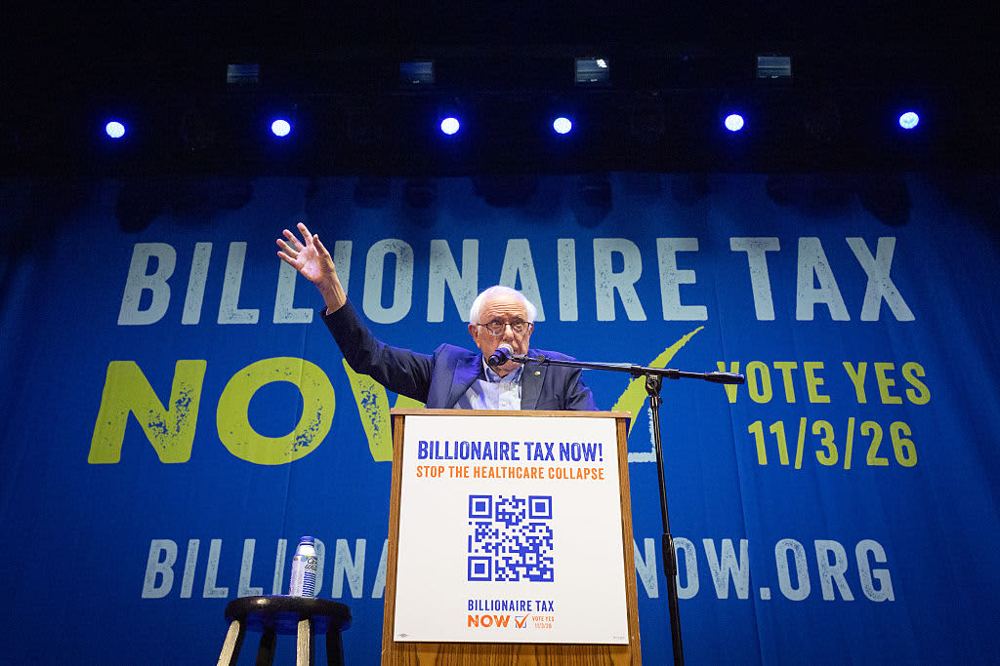
California's billionaire wealth tax, Proposition 40, looks like a close call based on recent polls. Here is what to know before Election Day on Nov. 3.
Proposition 40 , California's billionaire tax proposal, would authorize a one-time, 5% "wealth tax" on residents of the state with a net worth above $1 billion. The Nov. 3 Election Day ballot measure has divided politicians, the wealthy, economists, public policy groups, and voters, and it is looking more likely that the vote is headed down to the wire.
The initiative is a major test of the appetite for state-level taxation of extreme wealth, its result, economists say, could shape how other states approach wealth tax policy going forward.
In a University of California Berkeley Institute of Governmental Studies poll conducted in September, 45% of likely voters said they would vote "Yes" on Proposition 40, while 42% said they would vote "No."
The results continued a recent shift in the pollster's data, with the "Yes" edge shrinking from 7% to 3%. In its early August survey, UC Berkeley IGS found 48% of likely voters said they would vote yes. In its polling last March, "Yes" on Prop 40 had a 19% margin, with 52% of those polled expressing support and only 33% expressing opposition. According to its September poll, 13% of voters remain undecided.
A more recent poll conducted by Mason-Dixon Polling & Research for NBC Universal and Telemundo found "Yes" still has a sizable 10% advantage.
Large partisan differences characterize support and opposition to Proposition 40, with Democrats supporting it by more than three to one, while Republicans are opposed nearly eight to one. The views of non-partisan voters are similar to those of the overall electorate.
While "Yes" continues to have an edge in the polls, prediction markets see Prop 40 going down to defeat by a wide margin. Both Kalshi and Polymarket have the odds of passage currently at under 30%. These markets are not structured with methodologies used by traditional political polling.
The vast majority of the tax revenue would be used on state-funded healthcare programs, which will help offset healthcare cuts stemming from the One Big Beautiful Bill Act signed into law by President Trump last year, and which is estimated by the state's nonpartisan Legislative Analyst's Office to cost California "as much as tens of billions of dollars" though it says the impact on general funding will ultimately be determined by discretionary healthcare policy choices made by the legislature.
There are an estimated 200 billionaires residing in California, based on tracking of Forbes data.
Alan Auerbach, economics professor at Berkeley, said the concentration of wealth among a very small number of Californians is a key sticking point of the proposal. "Estimates are about 200 individuals," he said. "And even among this number, wealth is very concentrated among the [very] wealthiest."
Proponents of the measure say it could raise roughly $100 billion in new tax revenue, a figure that they say also accounts for 10% of tax avoidance and evasion.
The California Budget & Policy Center, a think tank focused on the needs of low- and middle-income citizens, describes the measure as one that "could potentially raise tens of billions in revenue in the short-term to preserve critical services."
That echoes the view of the state Legislative Analyst's Office, which estimates that the measure would raise "tens of billions of dollars," spread over a number of years.
The authors of a study from conservative-leaning Hoover Institution, including Stanford University finance professor Joshua Rauh, estimate $30 billion in new revenue , factoring in migration of billionaires out of the state and future constitutional challenges. But it is their outlook for longer-term economic harm, most recently updated in an NBER research paper published this month, that has attracted the most attention among those battling over the measure.
The idea of driving the super-wealthy away from the state has become a major area of concern for the plan's critics, who argue that "mobility" fundamentally undermines the tax base. The estimates of tax revenue depend in part on whether billionaires are able to leave the state and avoid taxes, and how many billionaires decide to take this action.
Many have pointed to Google co-founder Sergey Brin's purchase of a Miami home in March 2026.
Auerbach acknowledged the roughly $100 billion revenue estimate advanced by supporters but cautioned that assumptions about mobility and behavioral change on the part of taxpayers are so broad in range that it is possible to arrive at revenue estimates that are "negative if one accounts for future losses in income taxes from people who will have left California."
The California Budget & Policy Center said the measure "may also lead to some income tax revenue losses in future years to the extent that billionaires leave the state to avoid the tax."
The state's nonpartisan fiscal advisor stated that there is a "possible ongoing decrease of less than $1 billion per year in state income tax revenue collected from billionaires."
The Hoover Institution forecasts that with billionaires contributing $3.3, $5.8 billion annually in state income taxes, "permanently lost income tax collections from departures more than offsets the one-time wealth tax revenue, yielding a net present value of negative $38.9 billion."
One of the most vocal critics comes within Democrats' own ranks, as incumbent California Governor Gavin Newsom has frequently argued that a state-level wealth tax could weaken California's long-term tax base.
"The fight to make the wealthiest Americans pay more in taxes is not one we should be fighting state by state," Newsom said in a June Substack post . "You may not be able to pick up and move to Texas or Florida to shelter your income from taxation, but I promise you that billionaires can, and do. Wealth is movable, and it shops for the state with the lowest taxes."
Newsom, who earlier this month officially said he was a No vote on Prop 40, while a Yes vote on another measure that would bar the state from considering retroactive taxes, has also argued that the proposal could ultimately reduce funding for public services if high earners leave the state, reducing investments in needs like teachers, librarians, childcare, firefighting and police.
Xavier Becerra, the Democratic candidate for governor, said during a recent debate with Republican candidate Steve Hilton that "too many" California billionaires are not paying their fair share. He argued that when someone pays a lower tax rate than "a teacher, a firefighter, a nurse," they are not paying fairly. But Becerra said he will vote no on Proposition 40, because "this is not the way to do tax policy. ... What you don't do is, you don't have a policy where it's a one-time tax and it isn't predictable and sustainable," Becerra said.
"I agree that we can't drive more tax revenue out of our state, because we need that money here, and this initiative would do that," Hilton said.
The mobility question is critical when the wealth being targeted for taxation is concentrated in financial assets that can be moved, restructured, or shielded.
One of the proposal's drafters, Darien Shanske, a law professor at UC Davis, downplays reports of wealthy Californians relocating in anticipation of the measure. "This proposal was drafted by three law professors and includes a pathway for accelerated review for some issues because we are confident in the tax's design," he said. "Given the sledgehammer that the OBBBA took to services in order to pay for unneeded regressive tax cuts, it makes sense to close the loophole at least temporarily," he added.
According to Shanske, under longstanding California residency law, many highly publicized relocations may not meaningfully alter tax exposure under the proposal. Any billionaire residing in the state on January 1, 2026 would still be taxed, he said, based on longstanding California law . He also argues that many lawyers who represent the wealthy say even billionaires who bought residences outside the state before that date may face hurdles in challenging state tax law.
Shanske say some relocation rhetoric is politically strategic: "I conclude they are loudly doing these silly things in order to defeat the measure by creating doubt and confusion," he said.
But the legal and constitutional challenges that could mount in the event of the ballot measure passing are issues of significant debate, and led to a social media dustup this week between backers of the proposal and the authors of the Hoover Institution research.
Some opposition to Prop. 40 centers as much around valuation complexity as the possibility of wealth flight.
Indeed, Prop. 40's scope of taxation applies to a mix of liquid and illiquid assets, including public equities, private business stakes, venture capital holdings, and complex ownership structures. Real estate, pensions, and retirement accounts generally would be excluded from the tax.
"Valuing private companies and nontraded assets is an issue for any wealth tax," Auerbach said.
This issue is particularly relevant in California, where billionaire wealth is often tied to technology companies, startup equity and other illiquid assets whose valuations can fluctuate sharply and become contentious.
But Shanske says arguments that the proposal would prove administratively unworkable are unfounded.
"Most of the assets of billionaires are public and hence readily valued," Shanske said. "As for private companies, there is a default valuation formula based on the longstanding and successful formula used in Switzerland ," he said. "The tax can be deferred for 5 years (with a little interest) or deferred even longer if a taxpayer is truly illiquid."
Shanske says the most important point is that California's current tax structure largely fails to reach the wealthiest residents because billionaires often do not realize taxable income in the conventional sense.
"People at the very top do not pay much income tax because they do not earn much income, which is to say that, at the very top, California's progressive income tax is not progressive at all," Shanske said.
"The super wealthy do not earn much in salary, nor do they sell their assets and so they do not earn much in income. This is not a matter of serious debate," he added, citing the work of researchers who have long studied the issue and raised attention to the concentration of wealth in non-wage income.
In internal discussions, Meta founder and CEO Mark Zuckerberg recently threatened to leave the state if the wealth tax was passed into law, leading Meta's board to agree to insulate him from any financial and ownership impact by changing its stock structure, details revealed on Wednesday in an SEC filing .