Europe promotes sovereign, trusted AI as it struggles to catch US and China
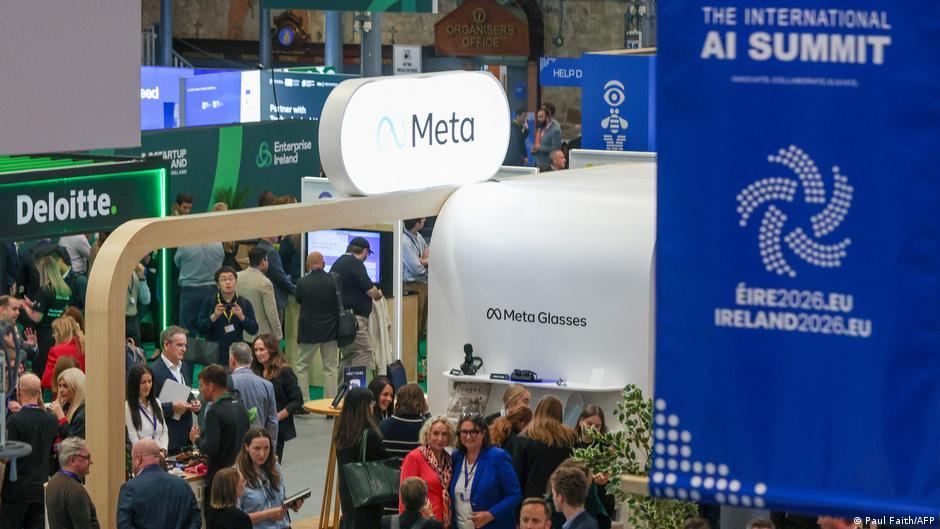
At an international AI summit in Dublin, European leaders promoted trusted and independent AI. Critics question whether the EU can close the gap with the US and China while maintaining strict regulation.
If supremacy in artificial intelligence (AI) was an Olympic discipline, there would only be two serious contenders for gold on current trajectories: the US and China.
Europe, as has been the case in many areas of cutting-edge technology in recent times, is barely in the conversation.
Former president of the European Central Bank Mario Draghi, whose 2024 report highlighted the EU's desperate need to be more innovative to become more competitive, said recently that AI is "perhaps the most promising" route Europe has to raise growth today.
However, he decried the fact that the EU controls little of the value chain. "Being cut off from AI, once the economy runs on it, would be more like being cut off from the US financial system," he wrote in an opinion piece for the Financial Times. "The effects would be catastrophic."
Draghi's spirit was on full display in Dublin on Wednesday at an international AI summit, convened by the Irish government as part of its 6-month stint hosting the rotating EU presidency.
The summit's motto, "Harnessing AI to Revolutionise Europe's Competitiveness", might as well have been dreamed up by the Italian former prime minister.
Harnessing AI has become a lot more complicated. A slew of controversies around AI agents going rogue, from the Hugging Face attack in June when 1,200 agents hacked an online platform, to an Anthropic-designed agent sending a fake tip to US police over an unsolved murder, have caused alarm.
Many from within the tech industry, including Microsoft founder Bill Gates and the leading AI frontier labs themselves, have called for a development pause in order for safety measures to catch up.
To view this video please enable JavaScript, and consider upgrading to a web browser that supports HTML5 video
Yet positivity was largely the name of the game at the summit, with tech and AI industry leaders joining Irish and EU politicians to declare AI's transformative economic and societal potential, whilst also emphasizing the need for strong regulation and safety standards.
Irish Prime Minister Micheal Martin made it clear that Ireland was all in on AI and echoed European Commission President Ursula von der Leyen 's recent assertion that the technology represented a "tipping point." He also repeatedly highlighted what he sees as the bloc's commitment to safety.
"We are determined to capture the dividend by mitigating the risks," Martin told the event. "In Europe, we have charted our path ... balancing innovation and opportunity with a trustworthy, human-centered approach to AI."
Meanwhile European Commission executive vice-president for tech sovereignty, security and democracy Henna Virkkunen revealed at the event that the EU had begun its first enforcement actions under its new AI Act, requesting information around security and safety from advanced AI model providers.
However, other topics which exercise AI's many critics, from those concerned about the massive environmental impact of data centers , to those warning about possible AI-related job losses, were largely absent from the discussions.
Outside the venue, a group of protestors led by People Before Profit, a left-wing Irish political party, criticized the summit for its lack of focus on such issues.
"There is a deliberate blurring of the line here with the type of AI that is being promoted," Alexandra Day, one of the protest organizers, told DW.
"It is really being pushed on workers with very little consent. There's no right for workers to opt out of using AI now that it's coming into the workplace."
Despite ramping up its data center capacity, it still lags far behind the US and China. It hosts 5% of the world's AI computing capacity compared to around 75% for the US.
The EU is conspicuously absent from lists of the leading AI frontier labs, with only French company Mistral coming close to rivalling the top labs. Its production of leading-edge chips is also nowhere near that of the top US or Taiwanese producers.
As part of its plan to make ground on the US and China, the Irish government, in its role as EU presidency host, presented a policy document at the event.
The so-called "Dublin Declaration" outlines political commitments to strengthen Europe's AI capabilities, including infrastructure investment and financial backing for European AI companies.
In keeping with Draghi's calls for Europe to develop its own AI sovereignty, particularly in supply chains and infrastructure, the declaration suggests that European firms reliant on non-EU cloud and computing services may face additional compliance pressures.
However, not everyone is convinced by the EU's capacity to either ramp up AI capacity or develop effective regulation.
Eddie Wilson, CEO of European airline Ryanair, said he doubted Brussels would be able to regulate AI well without stifling innovation.
"The last thing you want is people regulating this industry who don't know anything about it," he told DW. "That's generally what happens in Brussels."
Ryanair recently made a major deal with Google to use its cloud data system and its AI platform Gemini Enterprise. It's precisely the kind of collaboration with US AI supply chains that the EU says it wants companies to move away from.
"I worry for Europe because these tech companies need to move at speed," said Wilson, who believes the environment in the US is more amenable to innovation. "If they're not going to do it here, they're going to do it elsewhere. They're going to do it in China and they're going to do it in the US."