Azerbaijan hosts rare summit of both converging and opposing Middle East and Asian leaders
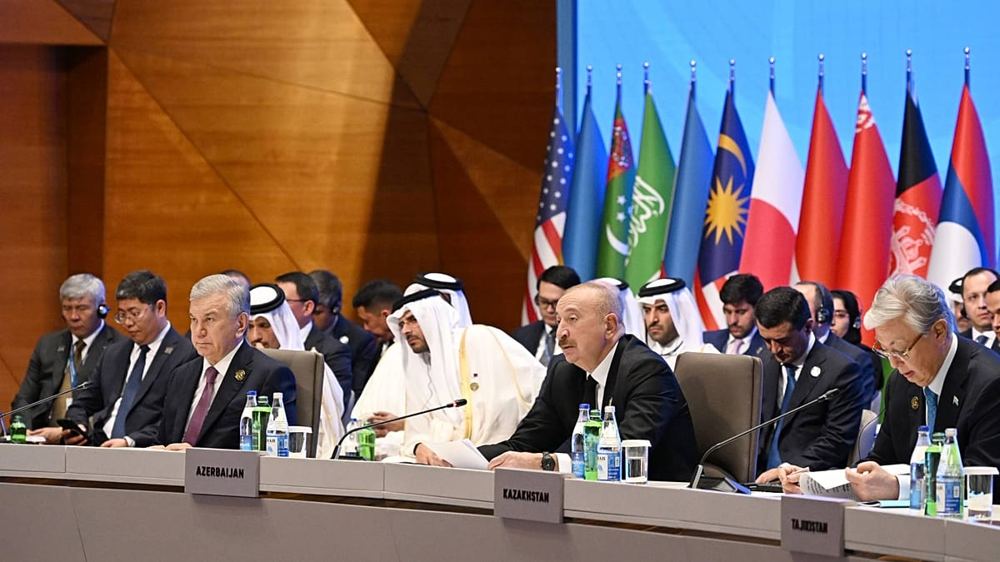
Middle East and Asian leaders, including those on opposing sides of conflicts, held a rare summit in Baku focusing on "confidence-building measures," addressing differences but also the opportunities of new transport corridors and economic realignments amid evolving global reshapes.
Leaders from across Asia and the Middle East including in-conflict countries met in Baku on Thursday to address their differences, leading to tense moments, but also to explore ways in which they can work together in the fast-evolving global climate of turmoil, both within the summit and in bilateral meetings.
Azerbaijan’s President Ilham Aliyev engineered bringing opposing heads of state and government under the same roof, as well as those seeking political and economic alliances, in a regional organisation focused on "confidence-building measures".
The summit hosted Israel President Isaac Herzog, Iran’s Deputy Foreign Minister Kazem Gharibabadi, Turkey’s Foreign Minister Hakan Fidan, Russia’s Foreign Minister Sergey Lavrov, Qatar’s Emir Sheikh Tamim bin Hamad Al-Thani, UAE Minister of State for Foreign Affairs Khalifa bin Shaheen Al Marar and a Palestinian delegation led by foreign minister Varsen Aghabekian Shahin who were joined by the presidents of Uzbekistan, Kazakhstan, Kyrgyzstan and Tajikistan as well as China's foreign minister Wang Yi and heads of state and governments from Laos, Cambodia, Vietnam, India and Sri Lanka.
The 7th Summit of the Conference on Interaction and Confidence-Building Measures in Asia (CICA), a multilateral forum aimed at promoting peace, security, and trust among Asian nations, focused on conflict resolution, transport connectivity, and digital transformation, with most leaders declaring their commitment to expand coordination across the Euroasian space.
Aliyev said that as his country sits at the intersection of Asia and Europe, it "plays an increasingly important role as a connecting hub in the Eurasian space.”
Kazakhstan's President Kassym-Jomart Tokayev said "our regions bring Eurasian countries together" and proposed a CICA transport connectivity strategy to increase transport links across Asia, arguing that economic cooperation can reduce tensions and build trust.
"In this regard, Kazakhstan relies on partnership, and last year a strategic partnership document was signed between Kazakhstan, Azerbaijan, and Uzbekistan; by signing the documents laying the foundation for the creation of the Caspian green energy corridor in the field of green energy, ensuring the transmission of produced goods and services to the European market via the Black Sea," Tokayev said.
"This corridor document will also yield benefits via the Baku-Tbilisi-Ceyhan pipeline," he added.
"The 21st century has already been called the Asian century. Whether it is called an era of peace or an era of separation and division, our responsibilities are still upon us, and based on joint measures, we can answer these challenges or achieve success," Tokayev said.
Azerbaijan and Kazakhstan's presidents also officially inaugurated the Trans-Caspian fibre-optic cable line on the Caspian seabed, which will increase digital connectivity between Asia and Europe from China and Central Asia towards Europe through the Black Sea as a key component of the wider strategic Middle Corridor project.
Uzbekistan's President Shavkat Mirziyoyev called for "an infrastructure of trust in Asia" based on transport and energy projects which would prevent future conflicts.
Underlining the role of CICA, Mirziyoyev said that "when dialogue weakens, the risk of wrong decisions being made increases. We must strive to ensure that political disagreements do not turn into armed confrontations."
Kyrgyzstan's President Sadyr Japarov said that according to UN reports, just this year 59% of global economic development will fall to Asia's share and as "international conflicts and technological transformation are accelerating, and ecological and climate risks are increasing."
"The Kyrgyz Republic sees CICA as a platform serving the common interests of Asian countries," Japarov added.
Vietnam's Vice President Võ Thị Ánh Xuân said, "We should also expand coordination between CICA, ASEAN, and other regional cooperation mechanisms, fostering closer links between Southeast Asia, Central Asia, and the wider Euro-Asian region."
The ongoing conflicts in the Middle East and their consequences were a key theme of the summit, alongside the opportunities of global reshapes, yet not without tense moments.
When Israel's Herzog began his address, delegations from Turkey, Iran, Kuwait, Pakistan and others left the hall, but the emir of Qatar and delegations from the UAE and Bahrain stayed to listen.
In his address, Herzog said his country focuses on "practical cooperation and pursues shared and mutual interests."
"The presence here of representatives of the Kingdom of Bahrain and representatives of other Arab countries is at the center of our attention and commendable," he added.
Noting US Secretary of State Marco Rubio's upcoming regional visit to Uzbekistan, Herzog reaffirmed Israel's commitment to practical cooperation in technology and water management, stating that "thanks to cooperation, there is no place for boycotts".
Herzog, who arrived in Baku on an Azerbaijani jetliner to fly through Turkish airspace, held talks with his Azerbaijani and Kazakh counterparts during the summit, praising their "excellent relations".
He also met Bahrain’s Foreign Minister Dr Abdul Latif bin Rashid Al Zayani, calling it "an excellent meeting.” During the Iran war, Bahrain was bombed heavily by Tehran, and the two countries have had icy relations for a long time.
During his speech at the summit, Al Zayani, speaking as a non-permanent UN Security Council member, called for the "full implementation of Resolution 2317, co-sponsored by 136 states".
"At sea, the disruption of navigation in the Strait of Hormuz and the dangers facing vessels in Bab el-Mandeb threaten global supply chains and the security of energy and food. Some 1,600 vessels have been held up, and more than 23,000 seafarers have been deprived of their freedom," he added.
"In the air, attacks launched this week by the Houthi militia against the airports of Riyadh, Abha, Jazan, and Najran have claimed civilian lives, among them nationals of states represented here. A grave violation of international law and the Chicago Convention," he emphasised.
He welcomed extending CICA's transport confidence-building measures to cover maritime and air navigation safety.
China's Wang said that "as transformations unseen in a century are unfolding at a faster pace."
Asia doesn't need the Cold War mentality, and it doesn't welcome block confrontation. Ultimately, problems in Asia should be handled by Asian people through solidarity and coordination," the Chinese foreign minister said.
Wang called for a diplomatic settlement between the US and Iran and said that "key shipping lanes like the Strait of Hormuz and the Red Sea should stay unimpeded," because "the complex evolution of the Middle East situation is having a profound impact on the world."
He also called for restraint in the Yemen fighting and said that "the question of Palestine should be brought back onto the right track of the two-state solution at an early date."
Palestine Authority's Foreign Minister Dr Varsen Aghabekian Shahin addressed the humanitarian crisis in Gaza and the expanding settlements, saying that foundational legal principles "cannot safeguard peace and security unless they are respected and applied without selectivity."
Quoting Prime Minister Mahmoud Abbas' recent UN General Assembly speech that Palestinians will not accept displacement, she called for the swift implementation of UN Security Council Resolution 2803 to guarantee a permanent ceasefire.
Uzbek President Shavkat Mirziyoyev warned delegates that "when dialogue weakens, the risk of wrong decisions being made increases".
He announced that Tashkent will host the 20th Non-Aligned Movement (NAM) Summit within two years to strengthen international crisis prevention.
Azerbaijan's Aliyev made a fiery speech against his country's past wars with Armenia over Karabakh, saying, "we expelled the occupiers from our lands."
"However, we did not take revenge on them for 30 years of suffering, genocide, and the destruction of our cities and villages," Aliyev pointed out.
"We offered peace. And for a little more than a year, we have been living in peace. This peace is still fragile. It needs to be protected and strengthened," he said.
Aliyev also spoke out against what he called "double standards and selective approaches in resolving interstate relations," and once more criticised the European Parliament and the Council of Europe for their policies towards Azerbaijan, calling them "outdated".
Leaders focused on artificial intelligence and digital infrastructure, with several calling for international standards to manage emerging technological risks.
Bahrain's Dr Al Zayani referenced his crown prince's call for an international treaty on AI governance, remarking that "no state alone can govern artificial intelligence, just as no state alone can keep a strait open".