She made college ‘good debt’ for herself. Can she do the same for her daughter?
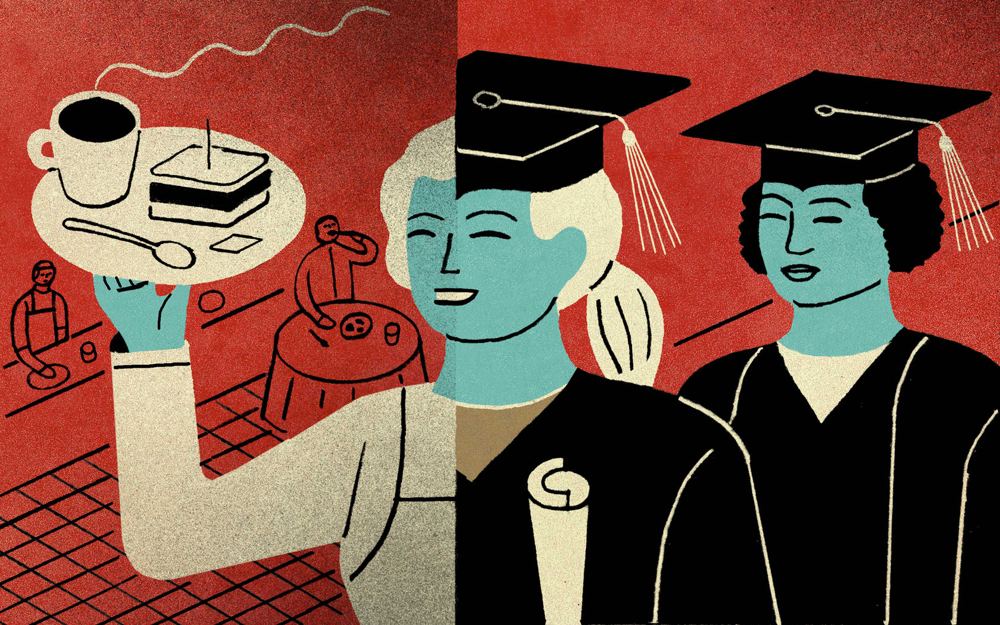
A generation ago, it was more common to put yourself through school. For reasons including rising education costs, It's a feat that's now far less manageable.
When Stephanie Thomas went to college more than 25 years ago, she relied on some financial help from her parents, student loans and a part-time job as a gymnastics coach to cover most of the tab. Even so, by graduation she had amassed about $20,000 in student loans, " good debt " she was manageably able to pay off over the years on an income-based repayment plan .
But when it came to her daughters' education, Thomas, now 49 and a certified financial planner in Raleigh, North Carolina, knew her family would need to work harder to limit student debt and boost the return on investment for a college degree. She and her husband saved diligently in 529 college savings plans and, as their daughters approached college age, looked for other ways to cut costs.
Thomas' youngest daughter, Ainsley, 16, is taking college-level coursework in high school through dual enrollment . By the time she receives her diploma, she'll also have a two-year associate's degree and enough credits to start a four-year institution as a junior.
It's a tactic more students are utilizing to shave years off the price of a bachelor's degree, according to the latest spring 2026 report from the National Student Clearinghouse Research Center , which showed a 9.6% jump in dual enrollment from the previous year.
There's good reason families are increasingly keen to cut college costs. Between 1995 and 2025, average tuition and fees rose 74% at private four-year institutions and 101% at four-year public colleges, after adjusting for inflation, according to the College Board , a nonprofit organization that tracks trends in college pricing and student aid.
"We're trying to be strategic about reducing the overall cost," Thomas said. "With the rising cost of higher education, finding creative ways to cut expenses feels much more practical."
A generation ago, it was much more common to do as Thomas did, but today self-funding an education with some financial aid and a part-time job has become far less feasible, experts say. Not only has the price of college significantly increased , but concerns have also grown about taking on the student loan debt needed to cover the tab.
Now, nearly half of families borrow money to pay for college, according to private lender Sallie 's recent How America Pays for College report, pushing outstanding student debt to a stunning $1.85 trillion , including federal and private loans.
During the Great Recession, deep cuts in state funding helped drive sharp tuition increases, shifting the costs to students, according to the Center on Budget and Policy Priorities, a nonpartisan research group based in Washington, D.C.
The brief recession sparked by the Covid pandemic triggered another wave of funding cuts for colleges and universities.
By the 2025-26 academic year, room and board, tuition, and fees reached $25,850 at four-year, in-state public colleges, and $45,780 for out-of-state students, on average, according to the College Board. At four-year private colleges, it costs $60,920 annually.
The burden on students increased as college tuition and other expenses hit record highs . These days, parent income and savings cover less than half of college costs, at 39%, while student income and savings represent 10%, Sallie's report also found. Free money from scholarships and grants accounts for about 27% of the costs, and student loans , including parent borrowing, make up most of the rest.
That debt load has become more difficult to manage: As of June 30, about 9.3 million federal student loan borrowers were in default , up from around 6.2 million at the same time in 2016, according to Education Department data released last month. That's a roughly 50% increase over the last decade.
Rising debt levels among graduates is part of the reason behind recent efforts by the Trump administration to curb access to federal loans , including implementing a total lifetime borrowing limit, to provide a check on soaring tuition costs.
Then, there's the question of the return on investment. Taking on debt, for instance, becomes far more palatable when the payments are affordable, and that can't happen without first being able to get a good job with a decent salary.
But the future of early-career employment is increasingly ambiguous, largely due to the rapid rise of artificial intelligence , according to the National Association of Colleges and Employers . Postings for entry-level positions in the U.S. sank 35% since January 2023, labor research firm Revelio Labs found, with AI playing a big role.
Jobs in technology and software development, for example, are under pressure, according to a separate report by job site Indeed. Alternatively, home health and nursing roles are more insulated, the report found.
Given an uncertain job market, families are questioning the value of college, and some students are forgoing a four-year degree altogether. Many are looking at alternative pathways and short-term programs , other research by the National Student Clearinghouse Research Center shows.
Enrollments in undergraduate certificate and associate degree programs both grew by about 2% last year, while enrollment in bachelor's degree programs rose by less than 1%, the research found. Community colleges now enroll 752,000 students in undergraduate certificate programs, a 28% jump from just four years ago.
Most parents of children under age 18 want their child to pursue some form of education immediately after high school, and ideally, a bachelor's degree, a recent Lumina Foundation and Gallup poll found.
Indeed, a four-year degree is still seen as the "gold standard," according to Courtney Brown, chief data and research officer for the Lumina Foundation, which is focused on advancing higher education opportunities. Even with the rise of AI, a college degree is widely viewed as the best pathway to upward mobility, particularly in tight job markets.
Ultimately, it's just less of a sure thing. "Americans haven't given up on higher education. They want it for their children … but they are questioning whether they can afford it," Brown said. The question is not whether college is worth the investment, she added, "but is it worth what it costs?"
For Thomas and her daughter, the calculus of finishing sooner is just too compelling. When Ainsley completes her associate's degree, she wants to attend North Carolina State University, a public college in Raleigh, for another two years. If all goes according to plan, she'll get her bachelor's degree in 2030. But by then, the family anticipates, she'll have cut the tab in half, and her borrowing costs to near zero.