Pokémon card values are soaring. What collectors should know before buying or selling
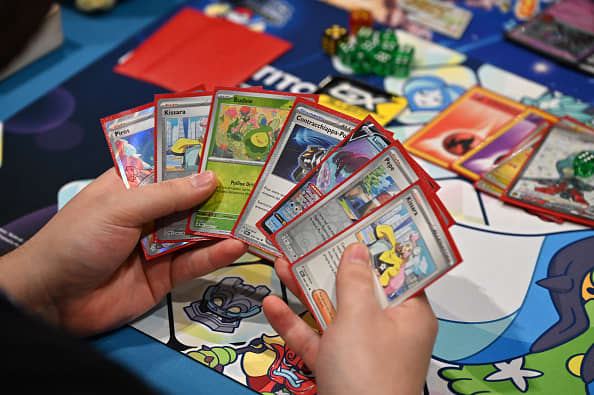
Pokémon card values are surging. Learn how grading, scarcity, recent sales and counterfeits can affect what collectors pay.
In 2022, a rare Topps 1952 Mickey Mantle baseball card, one of sports-card collectors' holiest grails, sold for $12.6 million. Wow, you say, that's a lot of dough for a thin piece of cardboard, slab of bubblegum not included.
Well, what do you say about a 1998 Pikachu Illustrator Pokémon card going for $16.5 million earlier this year? If you're pro wrestler and social media influencer Logan Paul, seller of the item, you say, Not a bad return on the $5.3 million (plus a trade) I paid for it in 2021.
Those are extreme examples, but a vivid illustration of how TCGs, shorthand for competitive trading card games, led by Pokémon, Magic: The Gathering and Yu-Gi-Oh!, are encroaching on an over-saturated sports-card market as an enticing investment opportunity. Throw in vintage and modern-day non-sports trading cards, depicting historical events and fictional characters ranging from the Civil War to Luke Skywalker, and it's a whole new ballgame.
The record $16.5 million Pokémon card sale is drawing fresh attention to a collectibles market where grading, scarcity and authentication can determine whether a card is worth dollars or hundreds of thousands.
"It is one of our fastest-growing categories that we've seen and one of the largest contributors to [our] growth over the last number of quarters," said Adam Ireland, vice president and general manager of collectibles at online marketplace eBay , which also provides authentication and price guides for TCGs and non-sports cards. "From an investment point of view, you start with Pokémon," he said. "It was the most searchable term within the eBay collectibles environment through the first half of the year."
Heritage Auctions, which deals in art, jewelry, coins and many other collectibles, launched a dedicated TCG department six years ago. "Now it's a $50-million category," said executive vice president Joe Maddalena. "That's just TCGs. I'm not talking about Star Wars and any of that stuff," he said, though he added that non-sports stuff contributed around $10 million to Heritage's overall sales in 2025, which topped $2.1 billion.
While buyers can find myriad non-sports cards for less than $10, almost like investing in penny stocks in hopes of eventually striking gold, Maddalena and Ireland cited some eye-popping sales on their respective platforms. A first-edition Pokémon Charizard card worth $20,000 pre-Covid is now valued by Heritage at $500,000. A Tyler the Great Warrior Yu-Gi-Oh! card shattered records when it was auctioned on eBay for $311,211, while Magic's Black Lotus card has gone for $500,000 on the site. Heritage sold a 1977 Luke Skywalker card for $687,500 in May.
Whereas collectability, value and investability of sports cards can rise and fall on the real-world performance of athletes, both trading-card genres share common factors. For instance, rookie cards of superstar athletes are highly coveted; the non-sports counterpart is referred to as first appearance. Especially critical are the authenticity, physical condition, total graded population, liquidity and pricing of specific cards, criteria determined by professional grading services such as PSA and CGC Cards.
PSA (Professional Sports Authenticator), founded in 1991, is the most recognizable grading service. Its process begins when a trained grader examines a card to verify its originality or genuineness, then assesses the quality and condition of the card using PSA's grading scale of 1 to 10, with 10 being the most pristine, aka gem mint. There generally are very limited populations of PSA 10s of highly sought-after cards, thus their astronomical values.
PSA has been grading non-sports cards since its inception, "but with more people viewing it as a potential asset class or thing they want to potentially invest in or speculate in, you're seeing more demand for grading services in the last seven years," said PSA president Ryan Hoge.
Indeed, PSA graded more than 19 million cards in 2025, up from two million in 2020. The company had already graded more than eight million cards as of last May, with output from January through April up 39% year-over-year. Much of that uptick, Hoge said, is attributable to TCGs. "Collectively, TCGs [account for] 50% of our current business, more than all the sports cards combined."
To keep up with escalating demand and address mounting complaints of long turnaround times, PSA's parent company, Collectors, which owns other vertically integrated services, including Beckett, SGC and Card Ladder, is investing $200 million into PSA's operations, doubling its physical infrastructure, implementing logistics technology and hiring 1,000 new employees, including hundreds of graders.
Trading-card collecting, of all types, is an intriguing and eclectic hobby, dating back more than a century. It's an increasingly lucrative market, too, but one that's hard to quantify, especially when it comes to calculating sales of new products versus aftermarket deals.
ICv2, an outlet that covers fandom culture, reported that sales of new TCG products alone reached $2.5 billion in 2025. "For this year, we estimate that it will be close to $5 billion," said editor-in-chief Milton Griepp, noting fervor surrounding the 30th anniversary of Pokémon. Figures from resale platforms like eBay and TCGplayer are diffuse, he said, "so estimates have air between the data."
Most familiar are sports cards, which for decades have portrayed past and active players from America's traditional pastimes, primarily baseball, but also football, basketball and hockey, and their best-known makers, Topps (acquired by Fanatics in 2022), Upper Deck, Fleer and Donruss.
Baby boomers grew up amassing sports card collections, largely for sentimental value, and maybe the bubblegum. But once those boomers started aging, cards not wrecked in bicycle spokes or tossed out by their parents accrued monetary value, creating not only a robust marketplace, but a new breed of investors. Buyers and sellers flocked to specialty card shops and shows, where scores of entrepreneurial dealers hawked vintage and modern products.
There was a significant surge in the sports card market in the early 1990s, driven by rising prices of 1950s and 1960s cards, and another during the Covid-19 pandemic when locked-down consumers, flush with disposable stimulus money, swelled the collector/investor ranks. Today it's a multi-billion-dollar industry that's shifted toward rare, iconic vintage cards, high-end inserts and overproduction of modern base sets.
"The sports side of the hobby has gotten so expensive," said Jeff Copeland, an emeritus professor of English at the University of Northern Iowa and a longtime collector of sports and non-sports cards. "In some cases, cards that sold 10 years ago for $20 are now $1,000. So collectors feeling the pinch in sports cards looked across the aisle at non-sports cards, remembered collecting them in their childhood and saw the value on the prices," said Copeland, who regularly writes for The Wrapper, a venerable non-sports fanzine.
There's also new money from investors just coming into the hobby, said Alex Tymchuk, a non-sports card dealer. "Maybe they weren't really into baseball or basketball [card] collecting, but they can relate to Mickey Mouse, Spider-Man or Captain America."
Likewise, Kit Young, an esteemed dealer among sports and non-sports card collectors, has seen an influx of "younger folks coming in with money. People think [the cards] are going to go up in value, so they're buying on the come based on the future."
TCGs and non-sports cards are considered very distinct categories. Hobbyists undoubtedly recognize certain cards' escalating values, but nostalgia, camaraderie and the pure fun of collecting are the prime motivators. "I would say that about 95% of those collecting non-sport cards today are not in it for investment," Copeland said.
Nonetheless, the investment community is gaining prominence, and making money, a lot of it on trading in TCGs. The genre originated in 1993 with Magic and was joined by Pokémon (1996) and Yu-Gi-Oh! (1999) as enduring blockbuster games played with specially designed cards that combine strategic deck-building with collecting. A plethora of TCGs have since come and gone, from American Idol to Game of Thrones, while others have thrived, such as One Piece and Disney's Lorcana. Speculators are also watching up-and-coming franchises, including Riftbound, Naruto and Dungeon Crawler Carl.
Non-sports trading cards comprise a much more diverse, more relatable universe of subjects and characters. Spider-Man, Batman, Superman, Wolverine and other superheroes evolved from comics to TV to movies, with trading cards at each iteration. A 1966 Donruss Spider-man PSA 9 card valued at $29 in 2013 sold for $175,100 last month.
Topps has produced non-sports sets documenting the Civil War, World War II and Desert Storm. Yet its most acclaimed, and valuable, such set imagined a fictional conflict. Mars Attacks, released in 1962, was a huge hit with kids, though many parents objected to the gruesome artwork of Martians eviscerating Earthlings. Although full 55-card sets even in poor condition can fetch around $1,500, Heritage recently sold a near-mint condition one for $268,400.
Another Topps hit is the Star Wars franchise, which has spun off more than 100 sets since the original film premiered in 1977. That translates to literally hundreds of millions of Star Wars cards in print, so investors can easily find individual cards or complete sets for nominal prices. At the other end of the price spectrum, there was the Heritage sale of a PSA 10 Luke Skywalker card for $687,500 in May. "That card is notoriously hard to find in that grade," Maddalena said.
As investor interest in non-sports cards and TCGs keeps growing, the market has developed an ecosystem that parallels traditional exchanges, indexes and brokers. Sports card shops and shows attract non-sports buyers and sellers, who rely on grading services for valuations and dealers for guidance and trends. While Heritage and other elite auction houses showcase cards and accept bids online and in-person, hobbyist websites, such as Vintage Non-Sports, Blowout Cards and Fanatics Collect, are doing a brisk auction business.
Collectors' PSA Vault, where millions of physical cards are stored, has a partnership with eBay, "that allows you to buy and sell very quickly," Hoge said. "It feels like a Robinhood or a Fidelity type experience."
A recent phenomenon luring investors is so-called "breaker" platforms where individual sellers live-stream auctions for TCGs, non-sports cards and other products in real time. A seller offers unopened packs of cards, boxes containing multiple packs or entire cases to buyers, who purchase individual spots. The seller breaks open the item, then each buyer receives the card or cards pulled for their spot. Whatnot is the most prominent platform, though Drip Shop Live, Fanatics Live and eBay Live are popular alternatives.
Another aftermarket trend is online gacha game platforms, including Collector Crypt and Courtyard, which bridge physical TCGs with blockchain technology. Tuomas Holmberg, CEO of Collector Crypt, said in a recent ICv2 interview that the company is running at a $50 million per month sales rate. GameStop's Power Packs gacha game, operated in conjunction with PSA, may be one reason why the company's collectible sales are surging, Griepp said.
Despite a market infrastructure that in many ways mirrors conventional methods for investing in stocks and bonds, there isn't a network of brokerages or regulatory guardrails around TCGs and non-sports cards. That puts the onus on buyers and sellers to perform their own due diligence.
"Like any investment, do your homework, know what's out there, know what the good deals are," Ireland said. Review online price guides that document the history of verified transactions and population data "so you know the level of scarcity behind any individual card," he said.
Beware of counterfeits, "a constant issue," Hoge said. "The technology continues to get better, so we have to stay on our toes to keep ahead of the bad guys."
PSA reported a more than 45% increase in counterfeit cards flagged by the company last year from submissions compared to 2024. There was a modest 5% rise in counterfeit sports cards, yet a 125% increase in fake Pokémon cards.
Maddalena's advice is to "buy the best. If you can only afford $1,000, buy the best $1,000 card you can. If you can afford $10,000, buy the best $10,000 card you can," he said. "If you speculate on a wide swath of stuff, you're going to get hurt. You're going to have things that go up, you're going to have things that become worthless."