Mega buyout funds underperform middle-market peers
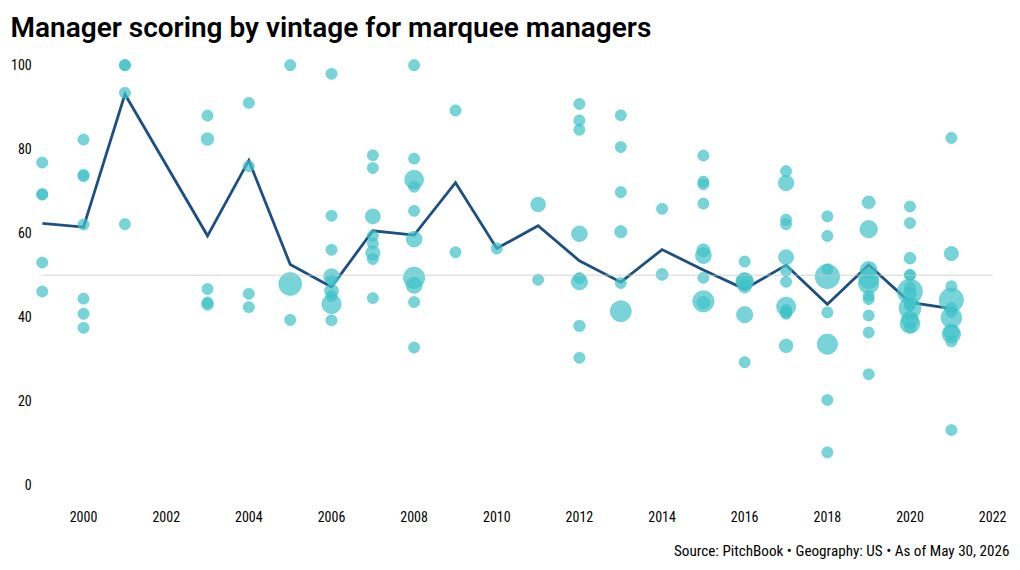
The largest private equity buyout funds have consistently lagged smaller peers over the past decade, signaling a structural shift in how scale impacts deal economics and investor returns.
The largest private equity buyout funds have posted consistently weaker returns than their smaller counterparts over the last ten years. According to a new analytical framework evaluating fund managers, the capital-weighted average performance of recent mega-fund vintages has dropped below the median for the broader buyout sector. This signals a structural divergence in the asset class based entirely on fund size.
This dynamic marks a sharp reversal from the 2000s and early 2010s. During that era, top-tier firms generated exceptional profits for limited partners, creating a growth flywheel that propelled flagship vehicles past the $5 billion mark. The momentum ultimately pushed several prominent general partners to list their management companies on public exchanges.
The current underperformance stems from fundamental changes in deal economics as funds scale. Writing massive checks limits the universe of acquisition targets to mature corporations that typically already possess sophisticated management and optimized operations. Consequently, mega-fund managers can no longer rely on traditional operational improvements to extract value.
Instead of hands-on operational engineering, these giant vehicles are increasingly relying on broad macro-economic bets. They are leveraging their sheer scale, brand recognition, and distribution networks to drive top-line revenue growth at their portfolio companies. This strategy fundamentally alters the risk profile of the investments away from classic private equity value creation.
Meanwhile, thousands of middle-market funds continue to execute the traditional buyout playbook. They target smaller companies where operational fixes, cost-cutting, and strategic overhauls can still generate substantial alpha. While the performance of these smaller funds is inherently more volatile, the ceiling for returns remains much higher.
This divergence creates a clear mandate for institutional capital allocators. Committing capital to mega-funds now offers a fundamentally different risk-return profile than it did a decade ago. Securing outsized returns in the current environment requires limited partners to conduct rigorous due diligence to identify middle-market managers with genuine alpha generation capabilities.